Resilience in focus at the NFU Conference 2026
How prepared is the financial sector for future shocks? Can Europe strengthen competitiveness without weakening the safeguards built after the financial crisis? And what role must employees and trade unions play in building resilience?
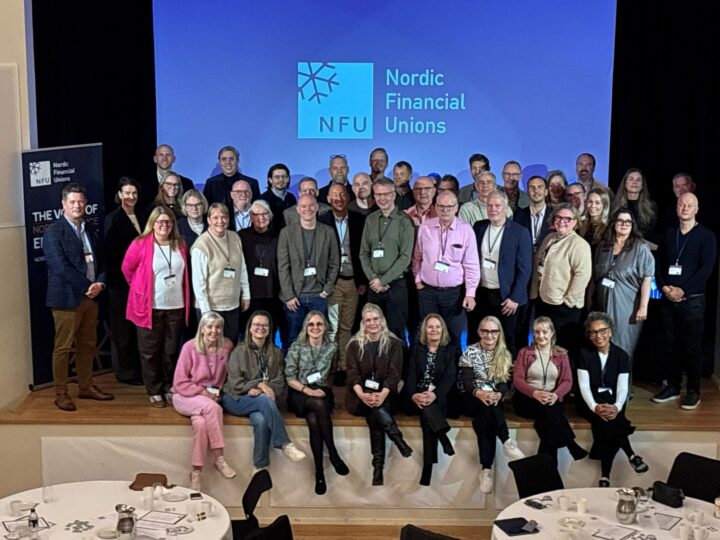
These questions brought together 50 shop stewards, trade union representatives and political leaders from across the Nordic countries for the NFU Conference in Reykjavík on 21–22 October under the theme “Resilience in an Era of Uncertainty and Change”.
Iceland provided a suitable setting. In a country where conditions can change quickly, questions of preparedness and adaptation are never far away. Over two days, the conference explored what resilience means for a financial sector facing financial, climate and cyber risks.
Resilience as a collective responsibility
Opening the conference, Ingvi Már Pálsson, Director General at Iceland’s Ministry of Industries, reflected on the increasingly uncertain international environment and stressed the importance of Nordic cooperation:
“We have an opportunity to share experience, strengthen common standards and ensure that resilience remains a collective responsibility.”
NFU President Michael Budolfsen followed with welcoming remarks, bringing the employee and trade union perspective:
“Resilience requires strong trade unions, strong collective bargaining and strong social values.”
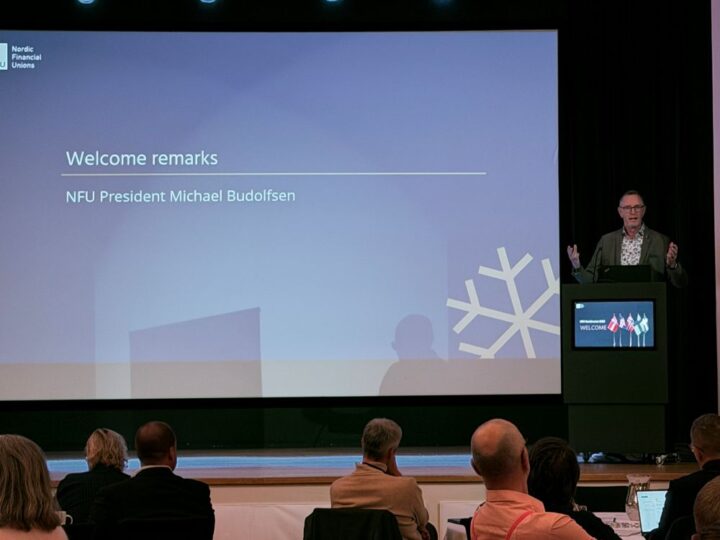
Michael Budolfsen, NFU president delivering the welcoming remarks.
Learning from the financial crisis
The first theme, financial stability and regulation, began with Jón Bjarki Bentsson, Chief Economist at Íslandsbanki, drawing on his first-hand experience of the 2008–09 financial crisis. He reflected on the collapse and recovery of Iceland’s financial system and the lessons it offers today.
The discussion then broadened to Europe. Bentsson was joined by Armi Taipale, Head of the Capital Markets Supervision Department at the Finnish Financial Supervisory Authority, and Jón Thor Sturluson, Chief Economist at the Swedish Financial Supervisory Authority. The panel was moderated by Anna-Delia Papenberg, NFU’s Head of EU Affairs.
While the lessons of the financial crisis remain highly relevant, the panel also pointed to new vulnerabilities. Rising government bond yields across major European economies and the United States have renewed concerns about financial stability and the resilience of sovereign debt markets, which can become particularly fragile when investors rush to sell and few are willing to buy.
Against this backdrop, the panel examined Europe’s drive for regulatory simplification and how to balance proportionate, effective regulation with the safeguards needed to ensure financial stability and resilience to sudden market shocks.
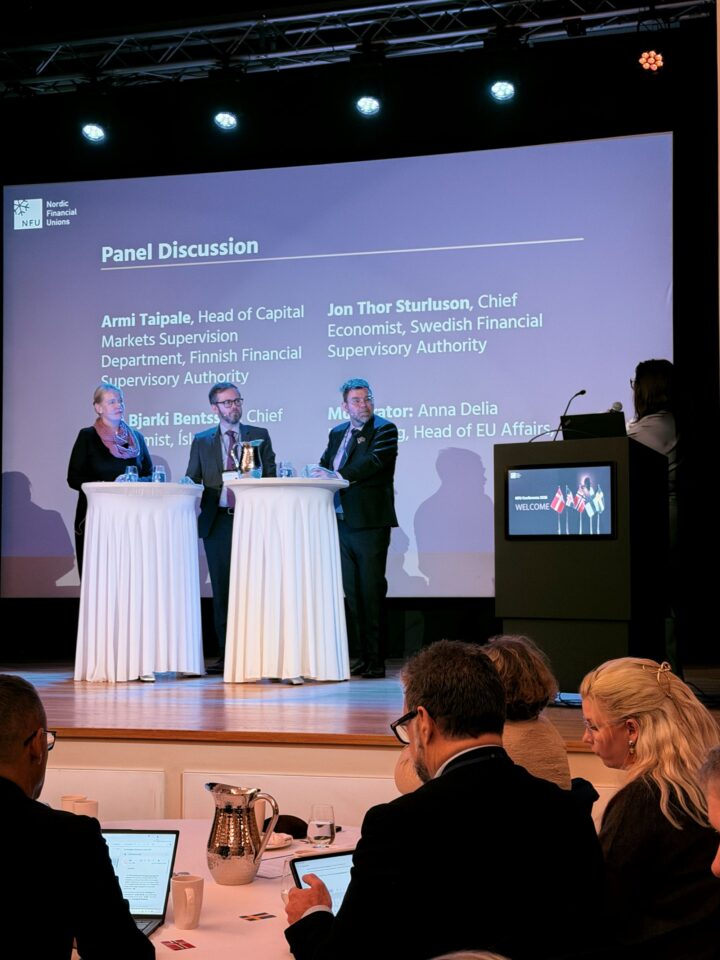
Panellists Armi Taipale, Jón Thor Sturluson and Jón Bjarki Bentsson with moderator Anna-Delia Papenberg.
Competitiveness, trust and social dialogue
Day two opened with European Commissioner for Financial Services and the Savings and Investment Union Maria Luís Albuquerque, joining online from Strasbourg. Linking resilience and competitiveness to trust, cooperation and strong institutions, she pointed to the Nordic experience of social dialogue:
“The Nordic tradition of social dialogue demonstrates that competitiveness and strong worker protections can reinforce one another. Reforms are more likely to succeed when people understand their purpose, have the skills to adapt and are involved in shaping the transition.”
She also stressed that, as financial institutions adopt new technologies and business models, investment in employees must go hand in hand with investment in technology.
Read the full address by Commissioner Albuquerque here.
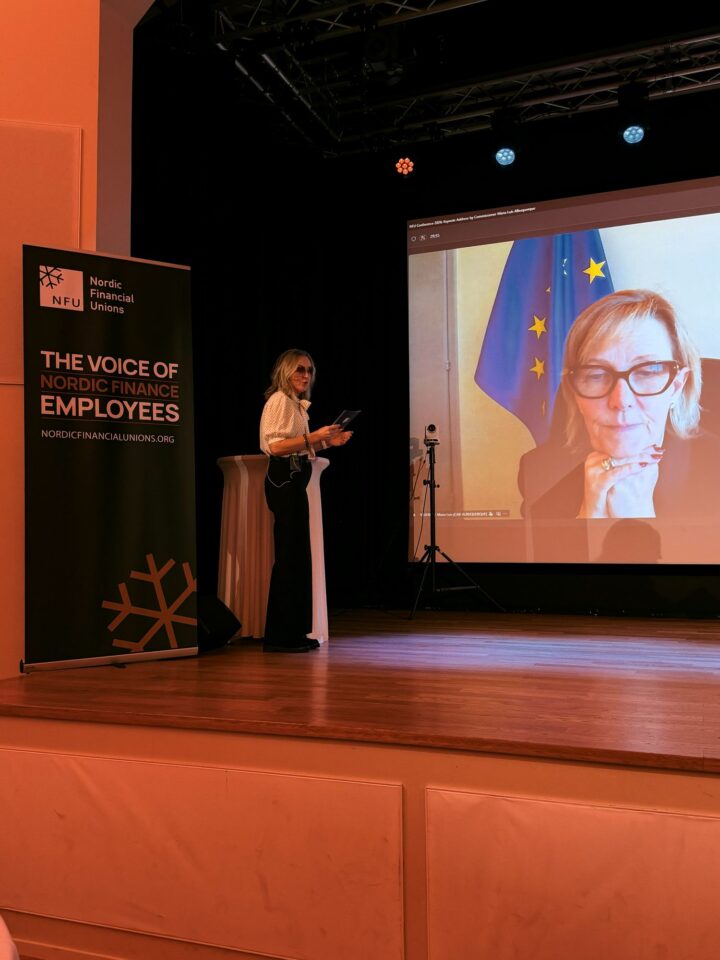
EU Commissioner Maria Luís Albuquerque joining online, with NFU General Secretary Carin Hallerström on stage.
Climate risk is financial risk
The conference then turned to sustainability and climate-related risks.
Halldór Björnsson, Group Leader for Climate Research at the Icelandic Meteorological Office, described how climate change is contributing to an increase in weather-related natural hazards.
Climate risks are not always immediate or local. They can originate far away and spread through supply chains, food systems, insurance markets and the wider economy. Understanding these connections is therefore becoming increasingly important for the financial sector.
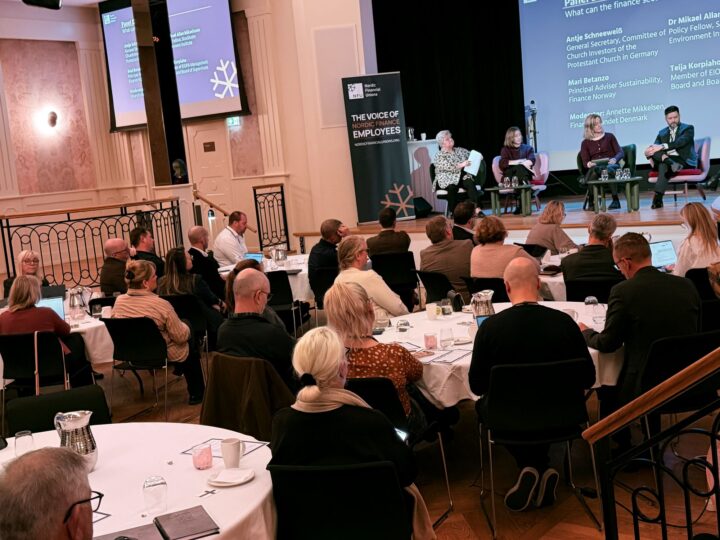
A panel moderated by Annette Mikkelsen, International Coordinator at Finansforbundet, examined what financial institutions can do in response.
Dr Mikael Allan Mikaelsson, Policy Fellow at the Stockholm Environment Institute, discussed how climate risks spread through insurance markets and argued that they should be recognised as financial stability risks. Mari Betanzo, Principal Adviser for Sustainability at Finance Norway, emphasised that sustainability should be understood as part of risk management, rather than simply as a compliance exercise.
Teija Korpiaho, Member of EIOPA’s Management Board and Board of Supervisors, addressed Europe’s growing insurance protection gap. Antje Schneeweiß, General Secretary of the Committee of Church Investors of the Protestant Church in Germany, drew attention to the social dimension of sustainability.
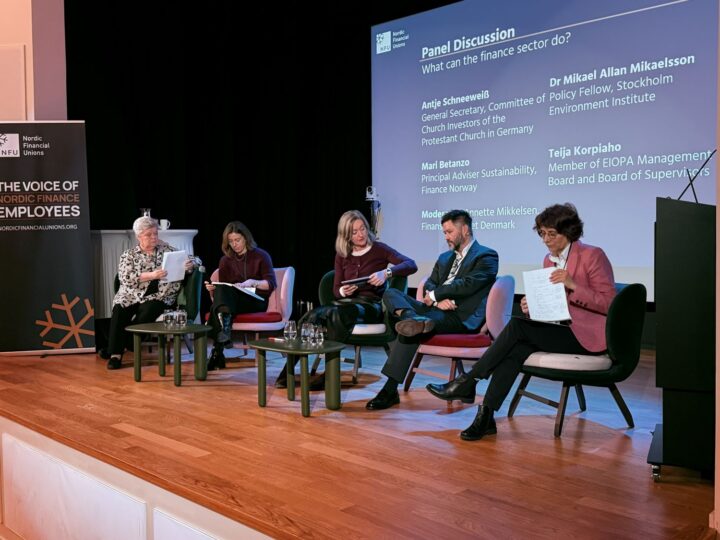
Teija Korpiaho, Mari Betanzo, moderator Annette Mikkelsen, Mikael Allan Mikaelsson and Antje Schneeweiß.
A changing security Landscape
The final theme brought the focus to technology, cyber risks and operational resilience.
Mikkel Storm Jensen, Military Analyst at the Royal Danish Defence College, outlined a changing security environment, including the growing threat of destructive cyberattacks by state actors.
While the financial sector is relatively well positioned, its dependence on trust also makes strong cybersecurity essential. Instability and insecurity can have serious consequences for financial markets.
A panel moderated by Dag Arne Kristensen, General Secretary of Finansforbundet Norway, explored what this changing threat landscape means in practice.
Morten Drægni, General Manager of Nordic Financial CERT, outlined the importance of Nordic sector-wide cooperation in tackling cyber threats and financial crime, while Vigdís Helga Eyjólfsdóttir, Cyber Security Specialist at Arion Bank, provided the perspective from within a financial institution.
Joining online from Brussels, Boris Petru Augustinov, Senior Policy Officer at the European Commission’s Directorate-General for Financial Stability, Financial Services and Capital Markets Union, discussed the EU’s regulatory approach, with a particular focus on the Digital Operational Resilience Act, DORA, and its role in helping the financial sector withstand, respond to and recover from cyberattacks.
The different perspectives pointed in the same direction: Cyber threats do not stop at organisational or national borders, and neither can the response. Cooperation across the financial sector, between authorities and across countries is crucial, alongside ensuring that employees have the knowledge and preparedness to respond.
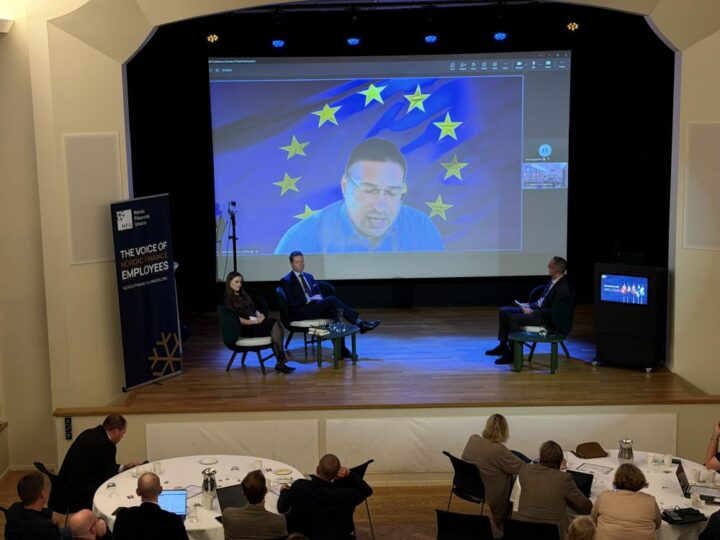
Vigdís Helga Eyjólfsdóttir, Morten Drægni, Boris Petru Augustinov (who joined online) and moderator Dag Arne Kristensen.
No resilience without people
The round-table discussions and Q&A sessions throughout the conference gave NFU affiliates space to bring the themes back to their own workplaces and the experiences of employees across the Nordic financial sector.
From financial regulation to climate and cyber risks, one message remained clear: resilience is not only about rules, institutions and preparedness. It also depends on how change is managed in the workplace and whether employees are involved in shaping it.
As NFU General Secretary Carin Hallerström stressed in her closing remarks:
“Employees are not simply expected to implement regulation, manage new technologies or respond when a crisis occurs. Their knowledge and experience are essential to identifying risks early and finding solutions that work in practice.”
Preparing for the next crisis means involving employees in the changes taking place today. For NFU, that is where trade unions and social dialogue have a vital role to play.